💡 This article was updated in August 2026 and forms part of the Infinitas Food Safety Help Centre
Natasha’s Law was introduced in October 2021 after the tragic death of Natasha Ednan-Laperouse. It requires food businesses to provide a full ingredients list with allergens highlighted on prepacked foods for direct sale (known as PPDS foods).
With an estimated 2.4 million people in the UK suffering from a food allergy, protecting the safety of those individuals has become vitally important.
This article outlines the essential steps your business needs to take to protect customers with allergies and intolerances and keep your business compliant with food law.
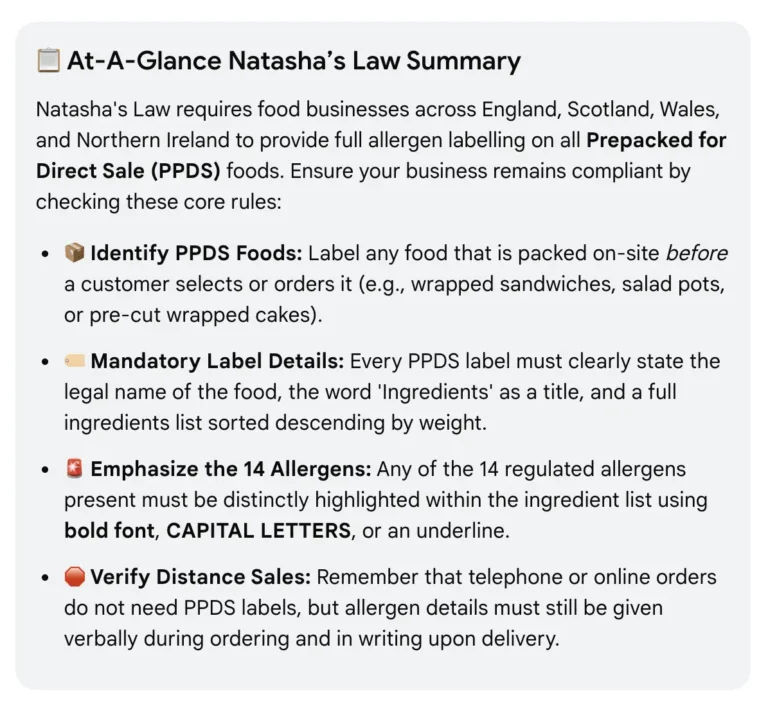
Table of Contents
What is Natasha's Law in the UK?
In 2016 Natasha ate a baguette from Pret-a-Manger that contained undeclared sesame seeds and died. Her death highlighted a legal loophole. Natasha’s Law was created to close that gap and prevent similar deaths. By improving food labelling, Natasha’s law aims to allow people who sufferer from food allergies to make safer, informed food choices.
When did Natasha's Law come into effect?
Natasha’s law came into force in October 2021. It amended the UK food labelling requirements. And it now means that caterers, retailers and schools must clearly label food classed as prepacked for direct sale (also know as PPDS).
Schools face unique challenges in managing food allergens. If you work in a school, read managing allergies in schools for practical advice.
Let’s start by explaining what the term PPDS food means.
What does PPDS food mean?
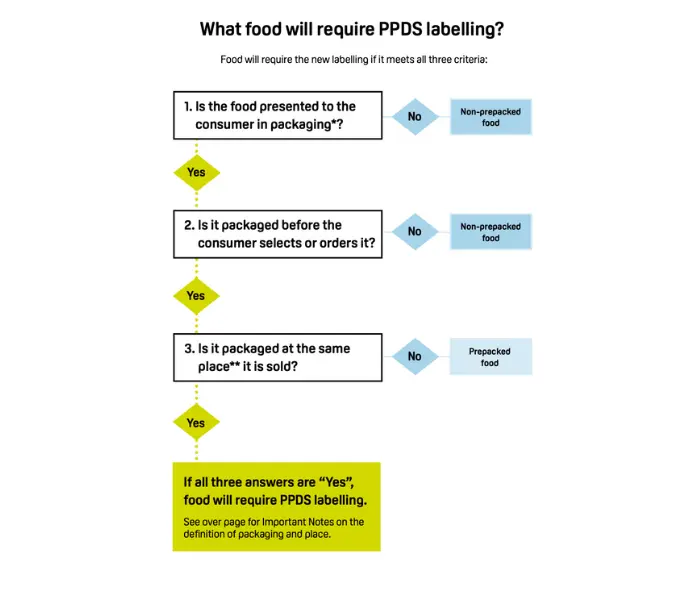
Under Natasha’s Law, PPDS food means food that is prepacked for direct sale. Specifically, this means food that is:
🔹 Prepared and put into packaging.
🔹 Pre-packed ahead of time before being offered for sale to the consumer (customer or pupil).
🔹Fully or partly enclosed by the packaging, and the packaging cannot be altered without opening or changing the packaging.
🔹 For ‘Direct Sale’ from the premises on which it is made.
To make things clearer, it’s helpful to go through some examples of PPDS foods, so that you can identify PPDS foods within your own business.
What are examples of PPDS food?
PPDS food includes:
- Sandwiches/cakes placed into packaging by a food business on the premises before it is selected or someone places their order.
- Pre-cut cake wrapped in cling-film ready for selection or purchase.
- Pre-packaged takeaway meals in sealed packaging before an order has been taken (e.g. burger kept hot under a hot lamp).
- Foods pre-packaged for sale on site (e.g. pizza, salad pots, rotisserie chicken).
- Meat products prepared by a butcher, and pre-packaged for sale on the same premises (e.g. burgers, sausages, spareribs) before putting on display.
- Food samples pre-packed on site (e.g. cookies) given to customers for free (as a promotion).
- Foods pre-packaged for an event and sold at a fete, market stall or mobile unit.
What are examples of non-PPDS food?
Non-PPDS food does not come under Natasha’s Law. However, these foods are covered by the FSA guidance for non-prepacked foods.
Foods that are non-PPDS include:
• Food that is not packed at all – it is sold loose (e.g. food from a salad bar, butcher’s counter, deli, takeaway or fishmonger). Loose food will be put into a bag or a box at the point of sale.
• Food that is prepared to order and served immediately (e.g. plated food at a restaurant or cafe).
• Food that is packaged after it is ordered and sold (e.g. takeaway food). Information must be available at the time the order is taken. And at delivery (e.g. takeaway food should display what allergens are in the food by use of a sticker).
• An open bag or box is not PPDS food (but twist the corners of a paper bag and it becomes PPDS). If the bag is open, allergen information must be available. But, full labelling under Natasha’s Law is not required.
• A cardboard sleeve around a baguette that is open at both ends is not PPDS food. Neither is a hot dog served on a cardboard tray PPDS food.
• Food that is packed by Business A and sold to Business B is not PPDS food. This is pre-packaged food. However, if pre-packaged food (e.g. a tray of Baklava) is bought by Business A then re-packaged by Business B, this would become PPDS food.
• Food that is sold from different premises by you (e.g. a stall or a mobile vehicle) is not classed as PPDS food.
There is another important type of food that does not come under Natasha’s Law and that’s distance selling.
How to determine if your food is classified as PPDS
Deciding which foods require labelling can seem confusing. To make things easier you could use the Food Standards Agency (FSA) Flow Chart. It will help you identify which foods are PPDS, and which foods are not.
Remember – once you have identified which foods are PPDS foods, these will require full ingredient labelling under Natasha’s Law.
How to handle allergen labelling for distant sales and delivery?
Food sold through the internet or telephone through a menu or flyer does not need to be fully labelled under Natasha’s Law because it does not come under the definition of PPDS food.
Despite Natasha’s Law not applying to distance selling, allergen information must still be communicated to the consumer. It must take place:
- at the start of the transaction (when the order is take over the phone), and
- at the point of delivery of the food.
Which countries in the UK does Natasha's Law apply to?
Natasha’s Law applies to food business operators throughout the whole of the UK. This means England, Scotland, Wales, and Northern Ireland.
What Are The Main 14 Allergens?
If any of the following 14 allergens are present in any PPDS food you sell or serve, your organisation must declare them on the food label.
It is important to remember that there are other known allergens, not included on the list. Examples include strawberries, or tomatoes. You still need to communicate with people about allergens in food, even if you don’t need to comply with the PPDS labelling requirement.
What Must PPDS Labels Include?
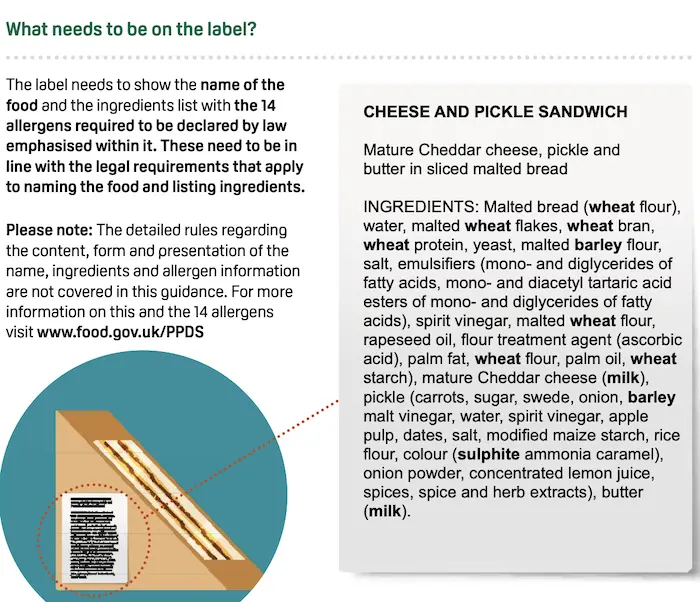
Under Natasha’s Law, PPDS food labels must include:
🔹 The legal name of the food, or a recognised customary name.
🔹 The full ingredients list in descending order by weight.
🔹 The 14 listed allergens emphasised in the ingredients list.
🔹 The word ‘ingredients’ as a title before the ingredients list.
How to format a Natasha's Law compliant allergen label?
If any of the 14 allergens are contained in food you sell or serve, the allergens must be clearly emphasised within the ingredients label. The guidance recommends you either use bold font, CAPITAL LETTERS, a contrasting colour or underline the allergen.
The use of contrasting colours may not be helpful to people who suffer from colour blindness, so keep that it mind.
How are 'may contain' warnings used on food labelling?
Precautionary allergen labelling (PAL) such as ‘may contain’ statements remain voluntary. These are not a legal requirement, but ‘may contain’ statements should only be used:
🔹 When there is a genuine risk of cross-contamination.
🔹 You can label them either as ‘may contain’ [XXX]’. Or ‘not suitable for consumers with [XXX] allergy’.
🔹 DO NOT use them as a blanket protection, without a risk assessment.
Check all food labels or food specifications for ‘may contain’ warnings and include these on your allergen matrix.
Natasha’s Law Checklist
To ensure your business or organisation complies with the requirements of Natasha’s Law, a simple checklist will help you to:
1️⃣ Identify which products fall under the PPDS category
2️⃣ Establish a system to track accurate ingredient information
3️⃣ Create compliant food labels to highlight ingredients and food allergens
4️⃣ Train staff on allergen awareness and the new labelling requirements
5️⃣ Implement cross-contamination controls in food preparation areas
6️⃣ Regularly audit your ingredients and suppliers to maintain accuracy
What are the consequences of failing to comply with Natasha's Law?
Failing to comply with Natasha’s Law can result in:
➜ Serious risk to the health and safety of any person who suffers from a food allergy (even a tiny amount of an allergen could cause death).
➜ Fines and legal action from your local authority, and/or civil action.
➜ A low food hygiene rating.
➜ Serious damage to your business’s reputation.
➜ Loss of customer trust/ loss of business.
➜ Potential business closure for severe violations.
Can poor allergen management affect your Food Hygiene Rating?
It is vital to remember that allergen compliance plays a role in your food hygiene rating score.
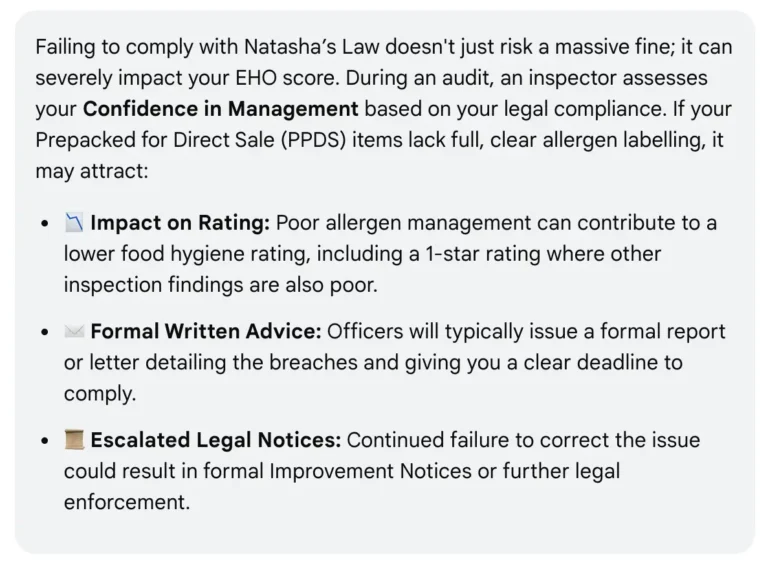
Poor allergen management, including failures to identify and control allergen risks, may contribute to a poorer rating where this affects the officer’s assessment of your food safety procedures or confidence in management.
Make sure you know exactly how to navigate Natasha’s Law before your EHO inspector arrives on site. No business wants to attract a low 1 star hygiene rating.
Natasha’s Law FREE Resources
Several 💡 resources are available to help you meet the requirements of Natasha’s Law:
➜ Explore the free resources on our Food Safety Help Centre and the Resources Page on our website.
➜ Try out our free Food Safety Helpline where you can ask questions about how to manage food allergens safely.
➜ Natasha’s Foundation provides Allergy School offering free resources for all nurseries, primary schools and out-of-school clubs, supported by the Kings Foundation.
➜ For practical tips on food allergy management in education read our post on Managing Food Allergies in Schools.
Conclusion
Compliance with Natasha’s Law is not optional. It is there to save lives. By following the rules you’ll ensure your business meets food safety legal requirements by delivering allergen information to consumers. Don’t get caught out – protect your customers and your business.